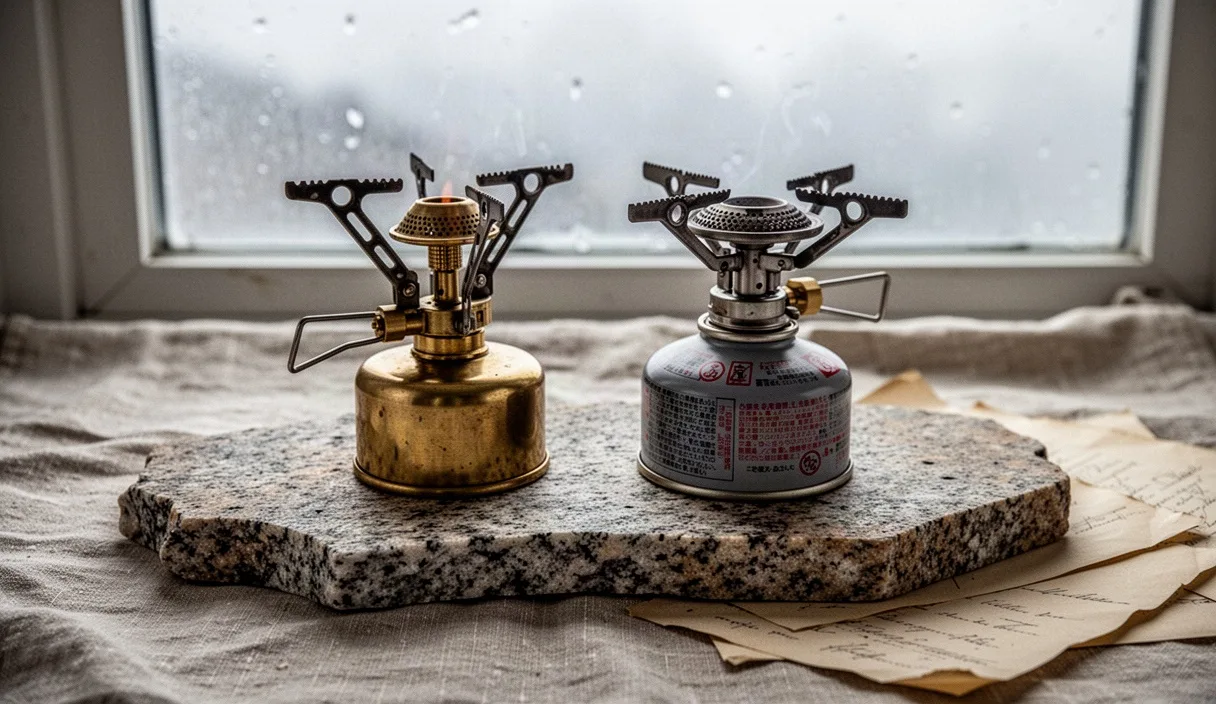
Ounces dictate pack comfort quickly. Isobutane canisters burn hot and fast, but their heavy steel walls add dead tare weight to your load. Open-well alcohol burners weigh under an ounce empty, yet they demand more ounces of liquid fuel for every liter of water brought to a boil. Choosing between them comes down to trip duration, expected wind speeds, ambient temperature, trail regulations, and resupply options.
Both systems have dedicated users on long-distance routes. An upright canister stove offers quick boiling, simple flame modulation, and an instant shut-off valve. A homemade or cottage-built alcohol stove provides silent operation, has zero mechanical moving parts to jam, and allows you to carry only the exact milliliters of fuel required for a weekend. Evaluating them requires looking past marketing claims and calculating real weights and burn times in field conditions.
Calculate Fuel Weight per Meal Cooked
Isobutane carries more usable thermal energy per gram than denatured alcohol or methanol. Standard blended canister fuel (80 percent isobutane and 20 percent propane) yields roughly 48 megajoules per kilogram. Methyl alcohol, commonly purchased as automotive gas-line antifreeze in yellow bottles, yields approximately 20 to 23 megajoules per kilogram. Because canister gas contains more than double the energy density by mass, you must burn more than twice the weight of alcohol to release the same amount of heat into your cookpot.
A standard upright burner consuming isobutane uses about 8 grams of fuel to bring 500 milliliters of 50-degree Fahrenheit water to a rolling boil. An open-cup alcohol stove uses roughly 18 to 22 milliliters of methanol to accomplish the same task, which translates to 14 to 17 grams of liquid fuel per boil. However, fuel weight is only half the equation. You must account for container tare weight.
A small commercial isobutane canister contains 110 grams of fuel inside a stamped steel shell that weighs approximately 100 grams empty. You carry that 100-gram steel shell until you reach a town with recycling or disposal facilities. By contrast, an alcohol kit uses a thin plastic bottle weighing 18 grams to hold 240 milliliters of liquid. On short outings, the ultralight dry weight of the alcohol burner and plastic bottle beats the canister system. On longer stretches between resupply points, the higher consumption rate of liquid fuel catches up to you, shifting the weight advantage back to isobutane.
| Trip Length and Boils | Alcohol System Total Weight | Canister System Total Weight | Lighter System |
|---|---|---|---|
| Weekend (4 boils, 500 ml each) | 148 grams (5.2 oz) | 283 grams (9.9 oz) | Alcohol |
| Mid-range (8 boils, 500 ml each) | 220 grams (7.7 oz) | 315 grams (11.1 oz) | Alcohol |
| Extended (14 boils, 500 ml each) | 328 grams (11.5 oz) | 363 grams (12.8 oz) | Alcohol |
| Through-hike section (20 boils) | 436 grams (15.3 oz) | 411 grams (14.5 oz) | Canister |
Calculations above assume a 28-gram titanium alcohol stove, an 18-gram bottle, and a 14-gram foil windscreen against a 73-gram canister stove head and a 110-gram net fuel canister with a 100-gram steel tare weight. The crossover point where canister fuel becomes lighter overall sits right around 16 to 18 boiling cycles, assuming adequate wind protection for both systems.
Compare Wind Resistance and Windscreen Needs
Wind ruins stove efficiency faster than low ambient temperatures. An unshielded 8-mile-per-hour crosswind strips the heat plume away from your pot base, doubling fuel consumption or halting a boil entirely. The two stove designs require completely different strategies to handle moving air.
Alcohol stoves operate under very low pressure, relying on natural convective drafts or simple capillary action. Because the flame velocity is weak, breeze easily disrupts the burn pattern. An alcohol stove demands a full-coverage, 360-degree windscreen positioned within a quarter inch of the pot wall. Systems like conical windscreens physically support the cookpot while enclosing the burner completely. They restrict intake air to small bottom pinholes and exhaust gas through top vents, concentrating every calorie against the metal pot sides. Without a snug, custom windscreen, an alcohol stove is useless in open alpine terrain.
Canister burners shoot fuel under high pressure through a micro-orifice, producing a forceful torch flame that resists light gusts better than alcohol flames. Burner heads with concave cups and raised lips protect the flame ports from side drafts. Even so, wind will siphon heat away from the bottom of your pot. You must block moving air to avoid burning through your gas canister before the trip ends.
Never wrap a continuous, tight foil windscreen around an upright canister stove. Trapping burner heat inside a foil shroud raises the temperature of the steel fuel canister. If the canister shell exceeds 122 degrees Fahrenheit, internal pressure climbs to structural failure limits, risking an explosion. Use these rules when managing wind around a canister:
- Position your pack, a log, or a boulder two feet upwind to create an eddy of calm air.
- Use only a small, clip-on windscreen designed to shield the burner head while leaving the canister base completely open to ambient air.
- Feel the steel canister wall with your bare hand occasionally during the boil. If the metal feels warm to the touch, shut the valve off immediately and improve ventilation.
Measure Boil Speeds in Low Temperatures
Speed differences between fuel types widen as the thermometer drops toward the freezing mark. In mild summer weather at 68 degrees Fahrenheit, an upright canister stove boils 500 milliliters of water in 3 minutes to 3 minutes and 30 seconds. A well-designed alcohol burner takes 7 to 9 minutes to heat that same water volume. When morning frost coats your shelter, thermodynamics alters the balance.
Canister fuel relies on internal vapor pressure to push liquefied gas out through the valve. Isobutane vaporizes down to 11 degrees Fahrenheit, while regular butane stops boiling into gas at 31 degrees Fahrenheit. Propane stays gaseous down to minus 44 degrees Fahrenheit. In cheap fuel blends containing high ratios of butane, the fuel stops vaporizing once the canister drops to freezing. The flame flickers down to a weak bead or dies completely, even when the canister feels half full.
Cold conditions require specific handling for canister systems:
- Store the fuel canister inside your sleeping bag footbox overnight to keep the core temperature above 45 degrees Fahrenheit.
- Set the stove base on a closed-cell foam pad during use so frozen ground does not draw heat out of the steel can.
- Place the canister base in a shallow bowl containing a quarter inch of liquid water. Liquid water cannot drop below 32 degrees Fahrenheit without turning to ice, providing a thermal buffer that prevents evaporative cooling from choking the gas flow.
Alcohol does not rely on pressurized vaporization inside a sealed can. However, cold liquid methanol refuses to catch a spark from a ferrocerium rod below 40 degrees Fahrenheit. You must preheat the burner base using a small wick, or warm the fuel bottle against your body for fifteen minutes prior to cooking. Once the burner catches, the heat of the flame maintains the fuel pool temperature. An alcohol stove will boil water in 28-degree weather, but expect wait times of 11 to 14 minutes per pot.
Verify Regional Fuel Availability in Small Towns
Long-distance routes run through isolated communities where specialized gear shops do not exist. Fuel logistics must dictate your stove choice before you pack your bag.
Isobutane canisters require threaded, self-sealing Lindal valves conforming to the EN 417 standard. While outfitter networks along the Appalachian Trail stock these canisters consistently, remote sections of the Continental Divide Trail or rural loops through national forests force hikers to rely on small-town gas stations, dollar stores, and post offices. General stores rarely carry threaded Lindal canisters. If they stock fuel, it is often 16-ounce heavy steel Coleman propane cylinders built for tabletop car-camping grills, which are incompatible with lightweight backpacking stoves without heavy brass adapters.
Alcohol fuel can be purchased in almost any populated zip code across the continent. Methanol is sold in automotive supply shops, convenience stores, and truck stops under the brand name HEET in a bright yellow bottle. It retails cheaply and can be divided into smaller bottles. Denatured ethanol is sold by the quart in hardware stores and paint supply shops. When using alcohol, know your fuel types:
- Yellow Bottle HEET: Near-pure methanol. Burns clean, leaves zero soot on pot bottoms, and lights reliably when pre-warmed. Found in gas stations nationwide.
- Red Bottle Iso-HEET: Isopropyl alcohol. Do not use. It burns with heavy black soot that coats cookware, clogs burner jets, and produces foul fumes.
- Denatured Alcohol: Ethanol mixed with poisonous denaturing additives. Sold in hardware shops. Excellent heat output, but quality varies by chemical blend.
- High-Proof Grain Alcohol: 190-proof liquor (95 percent grain ethanol) works cleanly in alcohol stoves. It costs far more due to liquor taxation, but it serves as an emergency fuel where hardware stores do not exist.
Legislation affects availability. The state of California banned retail sales of solvent-grade denatured alcohol in 2019 under regional air quality rules. Hikers in the Sierra Nevada relying on hardware store denatured alcohol must shift to yellow-bottle HEET or pack canisters instead.
Follow Local Fire Bans and Stove Rules
Western trails face severe wildfire dangers during summer and autumn. Land management agencies enact tiered fire restriction stages to prevent trailside ignitions. Ignorance of these rules risks heavy fines, confiscation of gear, and potential liability for fire suppression costs.
The United States Forest Service, Bureau of Land Management, and state forestry agencies enforce specific definitions regarding portable cookstoves. Under standard Stage 1 and Stage 2 fire restrictions, open flames are banned outside developed recreation sites. Most restriction orders explicitly require that portable stoves use gas, petroleum jelly, or pressurized liquid fuel, and must feature a dedicated manual shut-off valve that immediately kills the flame when closed.
Alcohol stoves fail the shut-off valve requirement entirely. Open-cup stoves, cat-food can stoves, and pop-can burners have no mechanical valve. If you kick an alcohol stove over in dry grass, burning liquid splashes across the ground, igniting dry pine duff instantly. Furthermore, alcohol burns with a nearly invisible pale blue flame in direct sunlight. You can reach across a burning alcohol stove without realizing it is lit until fabric catches fire.
Canister stoves comply with nearly all Stage 1 and Stage 2 orders because turning the brass valve shut starves the burner head of fuel within one second. During severe, late-summer Stage 3 total closures or exceptional fire emergencies, agencies occasionally ban all open flames, including canister stoves, requiring cold soaking. Always read the specific forest supervisor order for the ranger district you plan to cross rather than relying on generalized trail forum advice.
Common Mistakes
Avoid these frequent field errors that lead to lost fuel, broken equipment, or forest fires:
- Pouring fuel into a warm alcohol burner: Invisible leftover embers vaporize new fuel instantly, flashing flame up the liquid stream into your main plastic supply bottle. Always tap the burner base with a bare finger to ensure it is stone cold before adding fuel.
- Overfilling the alcohol cup: Filling an open reservoir to the brim causes liquid to splash over the sides once the fuel reaches a rolling boil, turning your windscreen into an uncontained fire ring. Fill the reservoir no more than two-thirds full.
- Guessing remaining canister fuel: Backpackers often discard half-empty canisters or carry redundant spares out of anxiety. Float your canister upright in a camp cup of water at home; the water line indicates the remaining gas level against the canister sidewall.
- Cross-threading the Lindal valve: Forcing a lightweight stove head onto a steel canister at an angle destroys the soft brass threads on the stove, ruining both pieces and releasing pressurized gas into the air. Thread the connection counter-clockwise until you feel the click of the thread start, then spin it down finger-tight.
Plan Your Cook System
Match your gear to the reality of your next itinerary rather than sticking dogmatically to a single cook system. Take these steps before packing your shelter:
- Check the fire danger level and agency orders for the specific wilderness zones on your route. If Stage 1 or Stage 2 fire restrictions are active, pack an upright canister stove with a working shut-off valve.
- Count the exact number of water boils you will execute between trailheads. If your itinerary requires fewer than twelve boils and fire rules permit open flames, use an ultralight alcohol burner, a custom foil windscreen, and a graduated fuel bottle measured for the exact volume required.
- Check the long-range weather forecast for sub-freezing night temperatures. If overnight lows will dip below 30 degrees Fahrenheit, select an isobutane burner, keep the canister in your pocket before breakfast, and bring a small foam insulating base.
- Locate your mid-trip resupply points on a topo map. Identify whether you will visit an established outdoor outfitter or a tiny roadside gas station. Choose canister fuel only when specialty gear stores are confirmed along the trail corridor.